
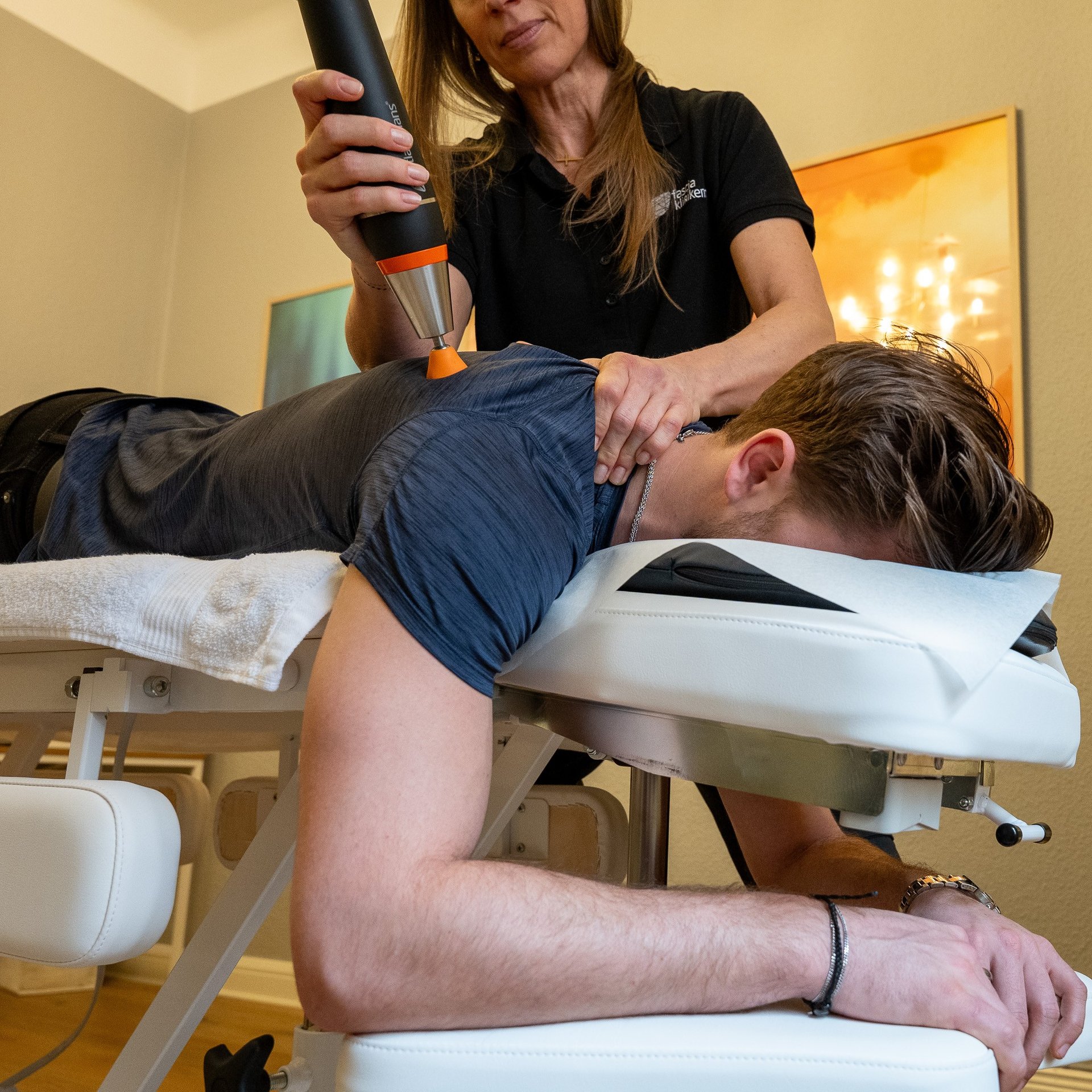
Machines Engineered for Next-Level Fascia Care
Fascia Treatment Equipment | How Our...
How the Machines Work
The machines are designed using the latest anatomical research and finely tuned for advanced, results-driven fascia treatment.
Increases Flow
Frequencies tuned to boost fluid movement in the tissue by 3–12 times, restoring fluid balance and activating self-healing as improved circulation helps rebuild the body from within.
Enhances Mobility
Encourages the fascia to release through mechanical stimulation, helping tight, adhered areas loosen so they can glide more freely and restore natural movement.
Relieves Pain
Engages pain receptors with varying frequencies that overwhelm their signals, producing a strong therapeutic effect without creating discomfort during treatment.
Why Focus on Fascia?
Recent research shows that Fascia has a much greater importance for health, aches and pain than previously thought. Fascia is a network of connective tissue, without beginning or end, that surrounds everything in the entire body — from muscles and skeleton to organs and cells.
- Accounts for more than one-third of the musculoskeletal system
- Contains most of our pain receptors
- Almost all communication in the body goes through the fascia
- Houses six times more nerve endings than muscles
When the fascia is damaged, sticks together or becomes inflamed, we experience pain, difficulty moving, and reduced ability to recover.
Fascia is affected by: Age, diseases, medication, diet, stress, sleep, air pollution, and psychological factors.
Everyone living a modern lifestyle with sedentary work and nutrient-poor food would benefit from regular fascia treatment.
How Your Body Responds to Treatment
The treatment may be gentle, but a lot happens in the body during treatment. Through harmonic pulsations, the Atlasbalans machines create wave movements that spread through the fascia like rings on water.
This allows large areas to be treated in a short time, both broadly and deeply. The treatment increases relaxation, circulation and fluid flow, which helps the body heal itself.
Treatment Duration: Typically 45-60 minutes
Frequency: Weekly or bi-weekly
Results: Often noticeable after first session
Movement of Fluid in the Tissue
That fascia is affected by mechanical stress and manipulation has been known for a long time. However, not everyone knows that this flow can be stimulated by static vibration to increase by 3-12 times depending on the frequencies used.
The machine uses frequencies optimized to increase fluid flow in tissue, which:
- Restores fluid balance
- Helps exchange of nutrients
- Facilitates waste removal
- Stimulates self-healing
Overstrained or strained parts can be stuck together and dry. The treatment shakes loose what is stuck, helping the body rebuild itself from within.
Research Foundation
This treatment is based on extensive scientific research:
Mechanical Effects on Fascia: Yahia et al., 1992 • Langevin et al., 2006, 2007 • Stecco et al., 2007 • Tesarz et al., 2011 • Elbrønd et al., 2015
Vibration & Fluid Flow: Reed et al., 2011 • Simmonds et al., 2010 • Roma et al., 2013 • Swartz, 2018
Pain & Nerve Endings: Langevin et al., 2009 • Hoheisel & Mense, 2015 • Mense & Hoheisel, 2016 • Wilke et al., 2017
How the Machine Relieves Pain
In the fascia there are six times more nerve endings than in muscles. Today we know that pain is usually located in the fascia, not elsewhere.
The Innovation:
The machine uses frequencies that stimulate pain receptors, but through constant frequency changes, the receptors become overloaded. The body prepares to receive one frequency, but then the next one comes — this means pain signals are not transmitted.
The Result:
- Deeply relaxing effect
- Treatment goes deep without nervous system resistance
- Bypasses strong defense mechanisms
- Resets muscle spindles stuck in contraction
- Restores normal muscle tone and function
Different bodies respond differently. Some resist more strongly than others. The machine's vibrations provide gentle but powerful treatment that gets past even strong defenses.
Research Study: Fascia Treatment for Frozen Shoulder
Frozen Shoulder is a movement disorder affecting approximately 40,000 people annually (Swedish statistics). Officially there is no cure — spontaneous healing may occur after 2-3 years. For those suffering, it means constant pain, limited mobility and reduced quality of life.
The study (2019)
Conclusion: There are clear indications that this type of treatment can help patients with Frozen Shoulder. We hope more studies will be conducted by larger institutions.